WOOX Daily Alpha Drop: July 7, 2026
Market Context
The crypto market enters the second week of July with cautious optimism. Bitcoin is holding above $63,000 after a sharp macro-driven short squeeze last week, while Ethereum is approaching $1,780. The broader altcoin market is recovering selectively — not everything is moving, but the tokens with real catalysts are separating from the noise.Today's Daily Alpha Drop covers three very different stories: a cautionary tale about DAO governance vulnerabilities, a real-world asset tokenization milestone backed by an SEC filing, and Cardano's most significant DeFi development in years.
$BONK: When Governance Becomes a Weapon
What Happened
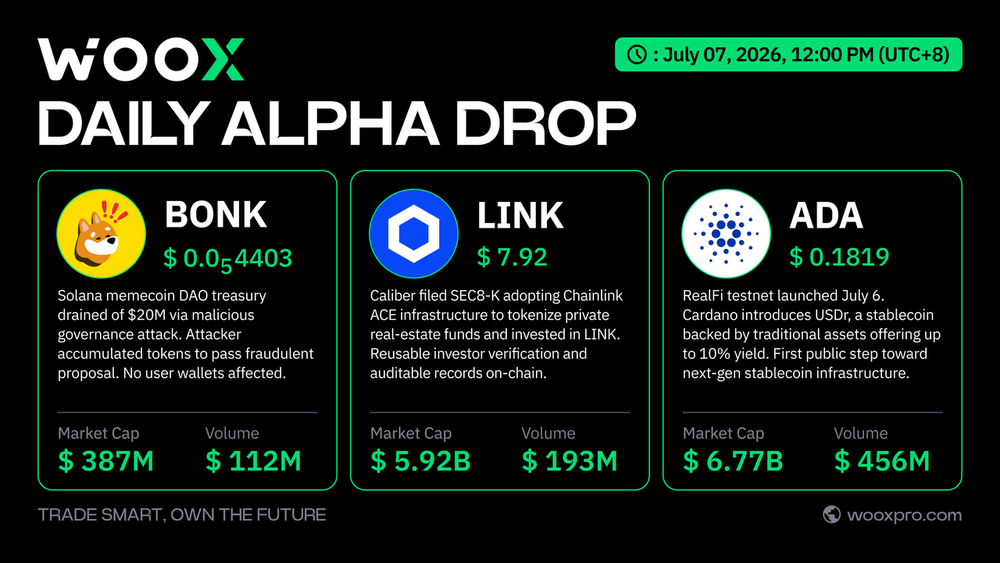
On July 7, BonkDAO: the decentralised autonomous organisation behind the popular Solana memecoin BONK, confirmed that its treasury had been drained of $20 million via a malicious governance attack. The attacker exploited a fundamental weakness in token-weighted voting systems: they accumulated a sufficient quantity of BONK tokens to pass a fraudulent governance proposal on Solana's Realms platform, then used that proposal to redirect treasury funds to their own wallet.Critically, no individual user wallets were affected. The attack targeted only the DAO treasury, funds held collectively by the protocol, not by token holders directly. Upbit and Bithumb temporarily suspended BONK deposits and withdrawals as a precautionary measure while the situation was assessed.
Why It Matters
The BonkDAO exploit is not just a BONK story, it is a wake-up call for the entire DAO ecosystem. Token-weighted governance, where voting power is proportional to token holdings, creates a structural attack vector: anyone with sufficient capital can accumulate tokens, pass malicious proposals, and drain treasuries before the community can respond.This is not a new vulnerability. Similar attacks have occurred across DeFi history, but the scale and visibility of the BonkDAO incident, involving one of Solana's most recognised meme assets, brings the issue back into sharp focus. BonkDAO is now working with exchanges, the Solana Foundation, and law enforcement to trace and recover the funds.
What to Watch
The incident is likely to accelerate discussions around governance safeguards across Solana-based DAOs, including time-locks on proposals, multi-sig treasury controls, and minimum voting thresholds. For traders, the short-term price impact has been a roughly 7% decline, but the longer-term narrative around BONK's community resilience and governance reform will be the more meaningful signal.
$LINK: Real Estate Tokenization Gets an SEC Filing
What Happened
On July 6, Caliber: a US-based real estate investment firm, filed an SEC Form 8-K announcing it is implementing Chainlink's ACE (Automated Compliance Engine) infrastructure to tokenize its private real estate funds. The filing also disclosed that Caliber has invested in LINK, the native token of the Chainlink network, to support its tokenization initiatives.The Chainlink ACE framework enables three core capabilities for Caliber's platform: reusable investor verification (KYC/AML checks that do not need to be repeated for every transaction), enforceable compliance rules embedded directly into smart contracts, and auditable transaction records that provide regulators and investors with transparent on-chain histories.Caliber will begin tokenizing selected investments, including its largest indoor Pickleball and Padel facility project, before expanding to broader real estate fund tokenization.
Why It Matters
An SEC 8-K filing is a material disclosure, it is not marketing copy or a press release. When a company files with the SEC to announce a technology implementation and a token investment, it signals genuine operational commitment, not exploratory interest. This is exactly the kind of institutional adoption signal that the Chainlink ecosystem has been building toward.The broader context is equally significant. The RWA (real-world asset) tokenization sector crossed $63.6 billion in market cap in July 2026, with tokenized real estate emerging as one of the fastest-growing sub-categories. Chainlink's oracle and compliance infrastructure is increasingly the default choice for institutions entering this space, given its established track record with BlackRock's BUIDL, Aave, and dozens of other major protocols.
What to Watch
Caliber's implementation is an early-stage rollout, but the SEC filing creates a public record that other real estate firms will reference. If the tokenization of Caliber's funds proceeds successfully, it could serve as a template for the broader private real estate market, a sector with trillions in assets that have historically been illiquid and difficult to access for retail investors.
$ADA: Cardano's RealFi Testnet Goes Live
What Happened
On July 6, Cardano developers launched the RealFi testnet, the first public step toward a next-generation stablecoin and DeFi infrastructure layer on the Cardano blockchain. The RealFi network introduces USDr, a stablecoin backed by traditional real-world assets that offers potential yields of up to 10% per annum without requiring users to lock up their funds.The RealFi testnet launch follows the Van Rossem hard fork (Protocol Version 11), which was completed in mid-June and introduced more efficient smart contracts and enhanced developer tooling. RealFi represents the first major DeFi application built on top of the upgraded Cardano infrastructure.ADA gained 30% in the week to July 6, making it one of the top performers in the top 100 by market capitalisation. The $981M in 24-hour volume is one of the largest prints the asset has recorded in 2026, reflecting genuine market interest in the upcoming developments.
Why It Matters
Cardano has long been criticised for slow development velocity relative to its market capitalisation. The RealFi testnet launch represents a meaningful shift: for the first time, Cardano is deploying a DeFi product that directly competes with established stablecoin and yield protocols on Ethereum and Solana.The USDr design, backed by traditional assets and offering yield without lockups, positions it as a direct alternative to products like Ethena's USDe and Ondo's USDY. If the testnet performs as expected and the mainnet launch follows, Cardano's total value locked (currently below $90 million) could see significant growth as DeFi users explore the new yield opportunities.
What to Watch
The RealFi mainnet launch date has not been officially confirmed, but the testnet going live suggests a timeline of weeks to months rather than years. Traders and developers will be watching closely for any issues identified during the testnet phase, as well as for announcements about institutional partners backing the USDr reserve assets.
Summary
Today's three stories span the full spectrum of what makes crypto markets worth watching: a governance exploit that exposes structural risks, an institutional adoption milestone backed by regulatory filings, and a long-awaited DeFi breakthrough on one of the industry's most established blockchains. Each tells a different story about where the market is heading and the risks and opportunities that come with it.
Trade smart. Own the future.
Not financial advice. Always conduct your own research before making any investment decisions.
Published by WOOX | wooxpro.com